If you have taken the Buffalo Trace Distillery tour, you know one of the things they are proud of is the fact that they have been in continuous operation since 1812. Even during Prohibition, “That Noble Experiment,” they continued to produce spirits, medicinal spirits, it is true, but still quality spirits. The 18th Amendment to the Constitution, along with the Volstead Act, prohibited the sale of spirits containing more than .05 alcohol, except for medicinal reasons or use in religious ceremonies.
There was, however, a monthly limit as to how much alcohol a doctor could prescribe to a patient. For a patient, doctors were allowed to prescribe only one pint of spirits every 10 days, a restriction that the American Medical Association opposed for being inadequate. The Volstead Act went into effect on Jan. 16, 1920.
As a side note, the sponsors of the Volstead Act used as one of their talking points that in 1919 the average American wasted $17 per year on alcoholic spirits, $17 that could be used more productively. In 1932, with Prohibition in full force and no inflation, the U.S. government reported that the average American spent $35 yearly on illegal alcoholic spirits.
There lived in Chicago, Illinois, in 1920, a pharmacist, who had changed his occupation to that of a lawyer. In 1920, he began to notice that many of his courtroom cases centered around pharmacists being charged with violating the Volstead Act. He also noted that these gentlemen always paid the bills he submitted promptly and in cash. After some investigation, the lawyer decided that there was money to be made by returning to his former occupation as a pharmacist, a pharmacist who specializes in the distribution of medicinal spirits.
He decided to relocate from Chicago to Cincinnati, Ohio, and open his new place of business there. Cincinnati was near to the distillery industry, and the city was blessed with an excellent transportation system.
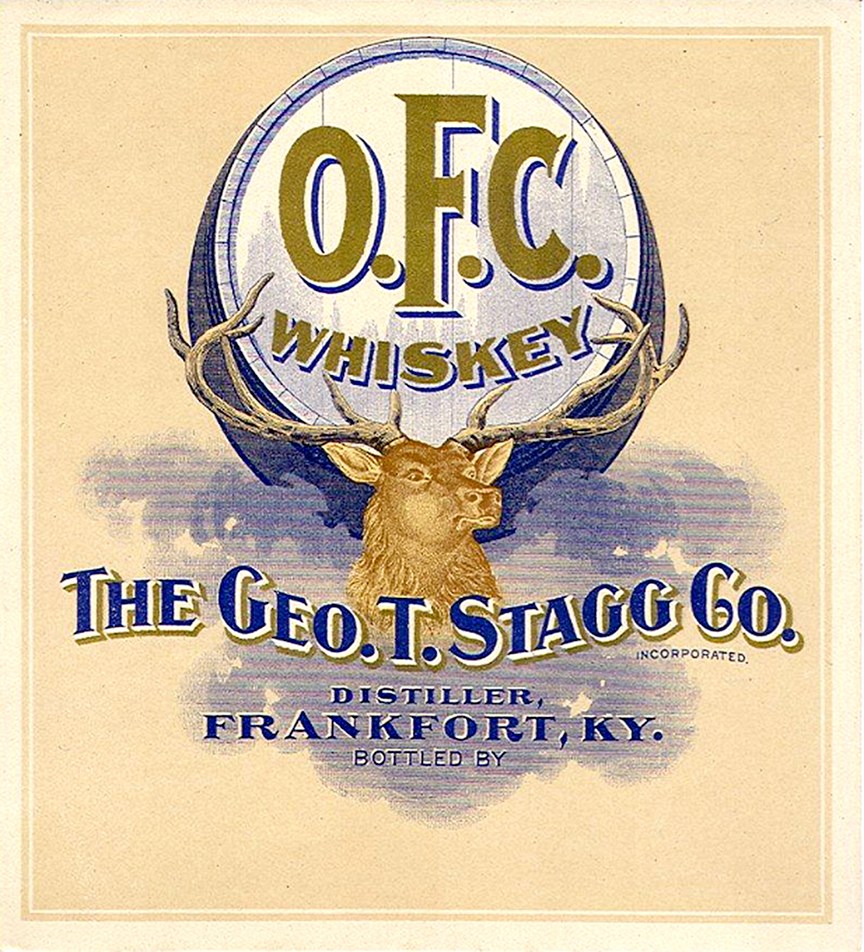
Once in Cincinnati, the lawyer/pharmacist searched for a pharmaceutical wholesale company to purchase. A pharmaceutical wholesale company was needed if he was to sell medicinal spirits to local pharmacies. The lawyer/pharmacist found such a wholesale company in Covington, The Kentucky Drug Company. He purchased this company. Once purchased, the Kentucky Drug Company immediately began placing orders with Old Fire Copper (O.F.C.) Distillery in Frankfort.
O.F.C. was owned by George T. Stagg. The typical order the Kentucky Drug Company placed with O.F.C. was for 200 cases, each containing 25 pint bottles of O.F.C. or 200 cases containing 48 half pint bottles of O.F.C
One of the problems the Kentucky Drug Company encountered was that someone at O.F.C. was in cahoots with those who made their living by hijacking trucks full of medicinal spirits and selling the alcoholic drink in speakeasies run by Al Capone. Time after time, a Kentucky Drug Company truck carrying 200 cases of O.F.C. bourbon was hijacked before it got to Covington.
Thank goodness the truck carrying the spirits was hijacked before it got to the Kentucky Drug Company warehouse. Since its load of spirits had not been entered into the Kentucky Drug Company inventory book, a new load of O.F.C. could be ordered.
On April 26, 1921, a Kentucky Drug Company truck driven by E. A. Brady carrying 200 wooden cases, each case containing 48 half pint bottles of O.F.C.’s finest, left George T. Stagg Distillery in Frankfort for Covington and got lost. The truck unknowingly crossed the Ohio River into Ohio and drove north on Ohio Route 4.
On the morning of April 27, 1921, the Kentucky Drug Company truck with its load of O.F.C.’s finest was entering Hamilton, Ohio, some 40 miles north of Covington. For some reason lost to time, the truck driver forgot the adage, “Expect a train at any time from any direction.”
Therefore, while crossing the Baltimore & Ohio Railroad (B&O) mainline, the truck was clipped by B&O passenger train No. 56. The local newspaper reported that the front of the B&O locomotive was bathed in bourbon and unbroken cases and bottles of O.F.C. lay trackside. Locals and passengers on the train quickly salvaged these unbroken bottles of O.F.C., filling their pockets and purses with this liquid gold.
By the time Butler County Sheriff Rudy Lanbach arrived at the accident site, the area around the train had been cleared of any unbroken whisky bottles, and he saw no reason to check the bulging pockets of nearby sightseers.
By the way, the pharmacist turned lawyer turned pharmacist who owned the Kentucky Drug Company was — George Remus. Yes, that George Remus, King of the Bootleggers.
The next time you drive through Falmouth, on U.S. 27, tip your hat to George Remus where he is buried in the roadside cemetery. Also, check out the bourbon history room at the Capital City Museum.