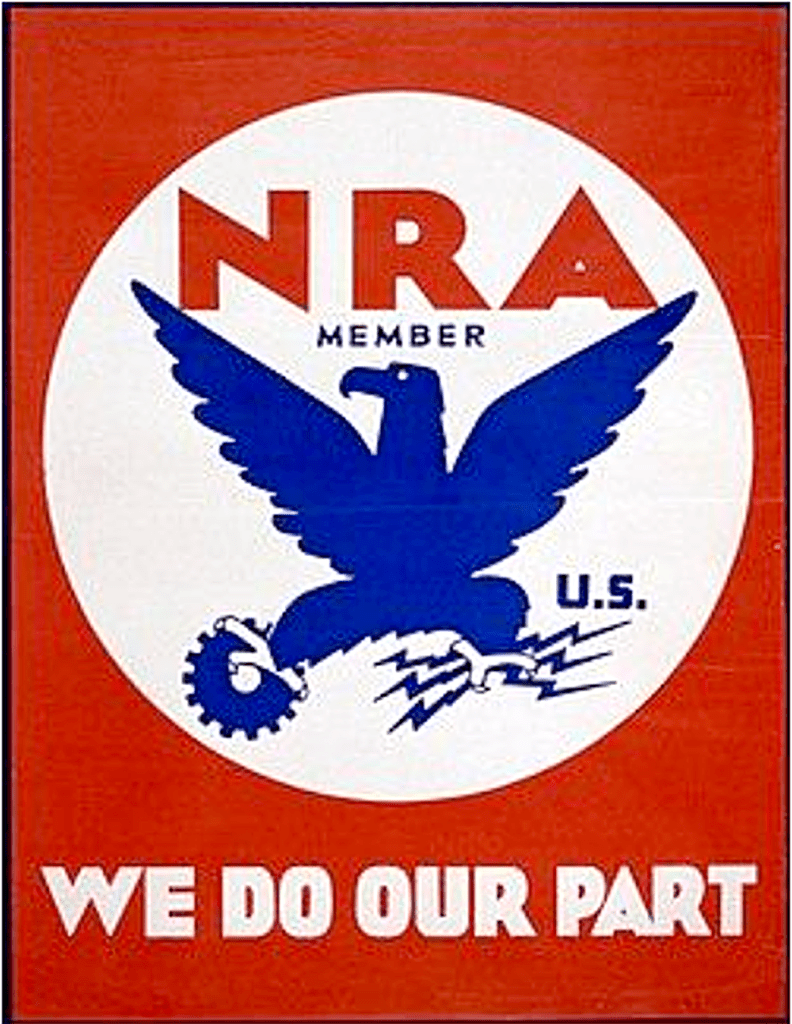
The year 1933 saw Frankfort’s storefront windows and entrances to its factories plastered with signs proclaiming their membership in the National Recovery Administration (NRA). The citizens of Frankfort as a whole refused to shop at a store that did not have an NRA sign in its window. Factories, which did not have an NRA sign on display, found their order books empty of orders. However, within a few short years, NRA signs had disappeared from Frankfort’s store windows and factory walls. Yet, for a brief shining moment, the NRA signs had changed Frankfort’s community from despair to embracing hope.
In October 1929, the Great Depression laid its hands on Frankfort and the nation. Unemployment grew to 25%, wages fell, the federal government suspended payment to its employees for one month and state government cut its work force. During the period 1930-1933, a dark cloud descended over Frankfort, filling citizens with gloom. Even the end of Prohibition in 1933 and the reopening of some distilleries had failed to generate the upbeat feelings that the coming of the NRA in 1933 generated.
In 1933, as part of the New Deal, Congress passed and President Franklin D. Roosevelt signed into law the National Industry Recovery Act (NIRA), a component of law which established the NRA. The stated goal of NIRA was to eliminate “cut throat competition” by having industry, banking, transportation, labor and government work together to adopt codes of “fair practices and fair competition.” Those industries and merchants which adopted nationwide codes of fair practices and fair competition, when approved by the federal government, would not be penalized by the Justice Department for organizing what only could be called a monopoly.
These codes of fair practices and fair competition set forth employee minimum wages, weekly hours of employment and industry wide recognition of unions. The 40-hour week was thus born. The codes of fair practices and fair competition also prohibited child labor, mandated employee rest breaks and laid out basic work safety standards. Many of these codes also contained provisions setting minimum sale prices, monthly production targets, how products could and could not be marketed, and what had to be and could not be in the finished product.
One of the main beliefs that led to the passage of the NIRA Act was that it would be a way to stop deflation and stabilize prices and wages. Nationwide deflation was causing finished goods to sell at less than the cost of production, therefore leading to a vicious cycle of less being paid the next time for raw materials. The farmer was losing money when bringing his harvested crop to market, while the coal miner faced a loss when delivering his coal to the coal merchant.
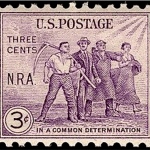
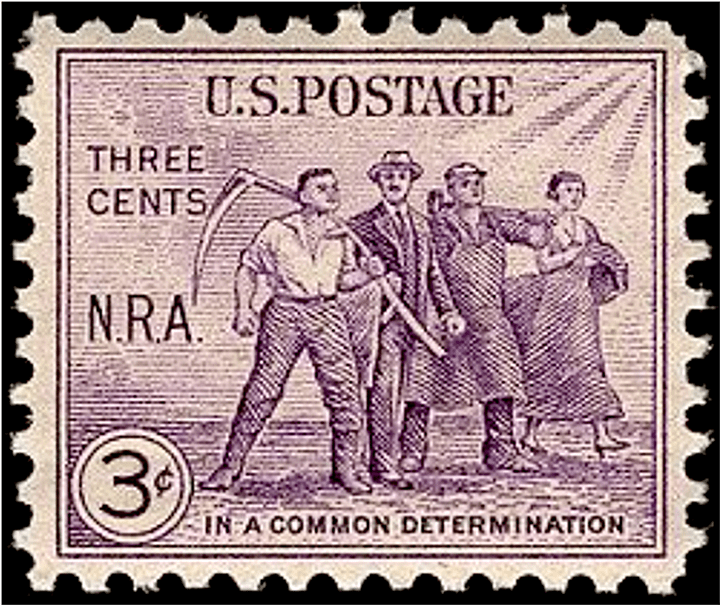
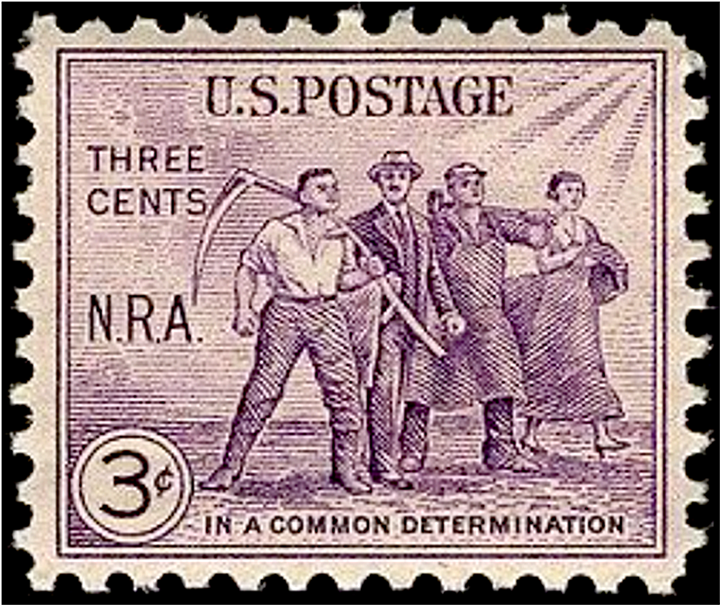
During the NRA’s life, store front window posters soon became an iconic feature within the United States and downtown Frankfort. The U.S. Post Office also issued a 3-cent stamp touting the achievements of NRA. The stamp showed three men and one woman each representing the farmer, merchant, worker and educator walking as a united unit. Beneath them was the wording “In A Common Determination.”
However, by January 1935, the general public began to realize that despite all of the hullabaloo concerning the NRA, there was no hope that the end of the Great Depression was within reach. Thus, on May 27, 1935, when the U.S. Supreme Court ruled various provisions of the NRA statute unconstitutional, in that they overstepped the legal authority conferred by the Constitution on Congress, few protested, but also there was little rolling back of the clock to pre-NRA days.
A majority of the provisions laid out in the NRA legislation were now accepted by the general public as the proper way of conducting business and thus continued in force. Unions were accepted by most industries as a necessary evil, child labor was no longer tolerated, the 40-hour work week was considered the norm and employee work rest breaks were provided.
Many of the labor provisions promoted by the NRA during its brief life were restated in the National Labor Relation Act of 1935, which is the foundation of today’s United States labor laws.
While short lived, the NRA had a profound and lingering effect on Frankfort both then and now.
The Capital City Museum would be interested in acquiring any Works Progress Administration materials focused on Frankfort or Franklin County.