There is nothing more enjoyable than going to Bardstown, Kentucky, and seeing the Stephen Foster Story. One forgets as one enjoys the musical that it is a part of The Lost Cause myth. The Lost Cause myth ignores all that was bad and ugly about Kentucky during the period portrayed in the play, particularly that of slavery. If there is any one eternal blemish on the commonwealth of Kentucky, it is that it was a slave state and did everything within its power to ensure slavery survived.
The commonwealth did not place its signature on ratification of the 13th Amendment to the Constitution of the United States, the amendment which abolished slavery, until 1976, some 110 years after it became the law of the land on Dec. 6, 1865.
Kentucky was legally a slave state from the day it was admitted into the Union, June 1, 1792, until Dec. 6, 1865 — illegally it was a slave state for a number of years later. Slave owners in Kentucky developed a number of subterfuges to get around the 13th Amendment. One of the main ways to ensure African Americans did not leave a farm was to provide them with housing and not pay them with cash but instead provide them with a line of credit at the local general store. No money meant no ability to purchase a bus or train ticket to leave the area.
It was during the period of 1792-1865 that Kentuckians practiced the most despicable acts against humanity. Slave families were torn apart with wives, husbands and children sold to other owners located nearby or hundreds of miles away. Kentucky, by 1850, had become a slave breeding factory.
Women slaves were encouraged to have numerous children so the surplus could be sold south. To be sold south meant that one was destined to spend their remaining life working in the cotton fields of the lower south where death from disease and exhaustion were a constant companion. The result of this way of life was that slave families were constantly being destroyed as their owner sought ready cash, a way to lower costs, close out an estate or get rid of a surly individual.
In the years after the Civil War (1861-1865), former slaves sought to find family members who had been sold to owners elsewhere in Kentucky or within the lower south. African American newspapers began to spring up throughout the south. Their operations were sporadic, but they allowed a way for members of the African American community to communicate with a larger audience.
Former slaves looking for lost family members would address an “Information Wanted” letter to those newspapers. These letters would contain what information a individual knew about the lost family member he or she was looking for, plus a return address. The letters were printed for free by the African American newspapers as a source of news. In turn, the “Information Wanted” letters were read out by African American ministers at church services to their congregation and by Freedmen’s Bureau workers at mass meetings.
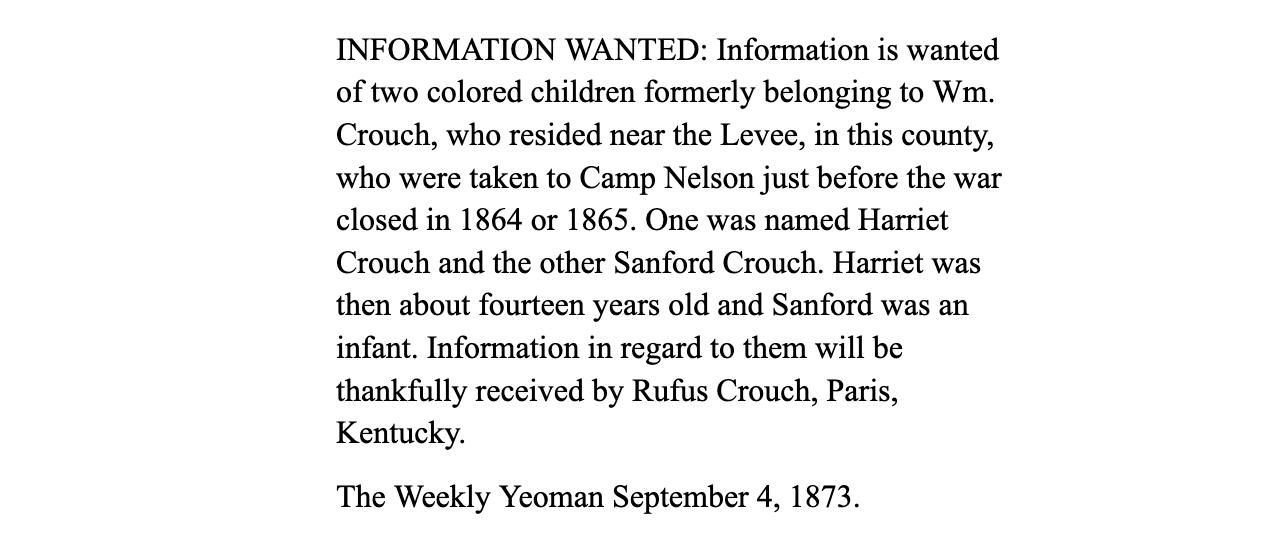
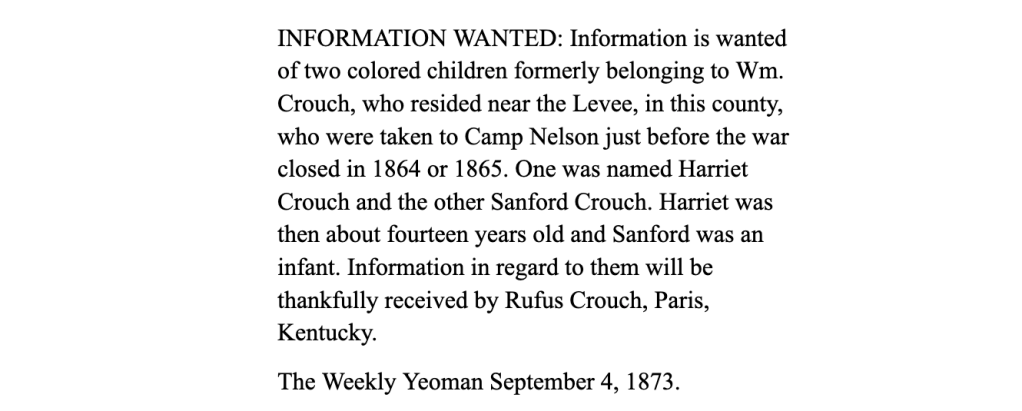
Some of the “Information Wanted” letters were also published in white-owned newspapers. Such is the case for a letter published in Frankfort’s Tri Weekly Yeoman on September 4, 1873. We do not know the relationship of Rufus Crouch to the two individuals he was looking for, why the two went to Camp Nelson, whether they left Frankfort with Wm. Crouch’s permission, or were runaways. Nor do we know if Rufus ever found Harriet and Sanford or learned their fate.
For those wanting more information on former slaves seeking loved ones during the years after the Civil War, I would recommend the book “Last Seen” by Dr. Judith Gesberg.