The American Civil War, 1861-1865, changed the United States forever. One of the subtle changes was that treaties with foreign governments no longer stated, “The United States of America are,” but now read, “The United States of America is.” However, of far greater importance is that the United States took the first steps in turning the United States into a world economic power.
President Abraham Lincoln and his cabinet were faced with the problem of how to finance the war — the cost was soon exceeding $1,000,000 per day. There was no way tax money could cover this cost. Stepping in to solve this dilemma was Jay Cooke, owner of Jay Cooke & Company of Philadelphia. In the past, the United States Treasury Department sold bonds to finance its wars, but these bonds had only been offered to a few individuals and institutions. Cooke proposed to sell United States Civil War bonds to anyone and everyone.
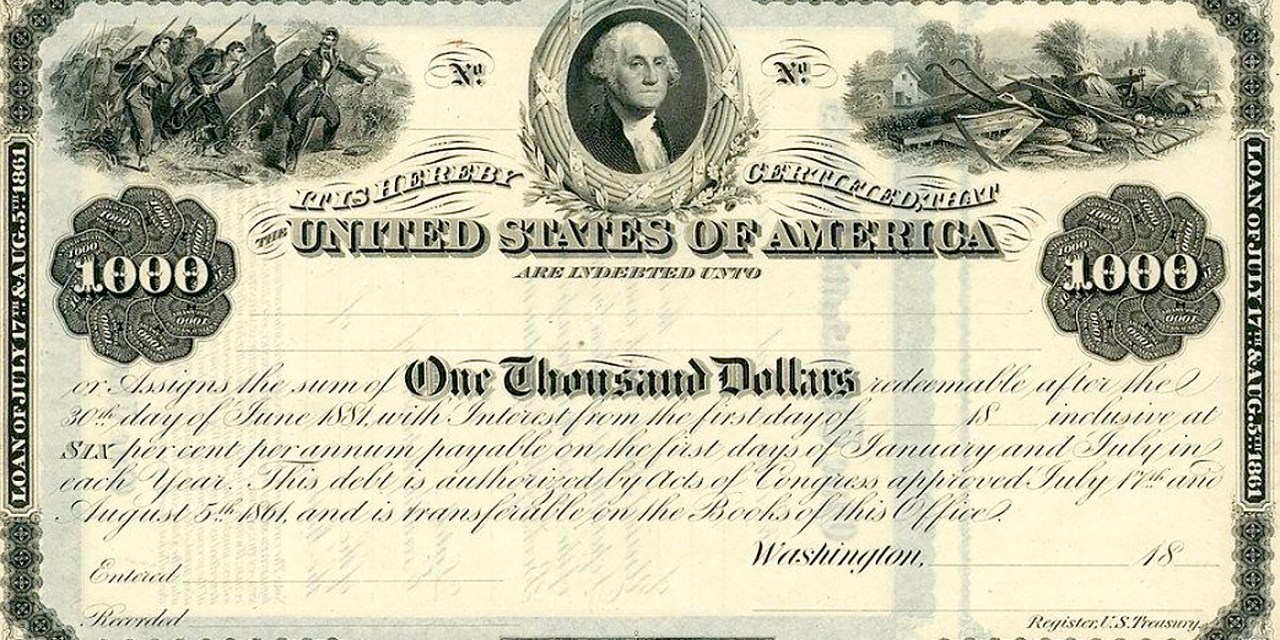
Cooke’s plan was to sell bonds paying 6% interest. The bonds would have a face value of $50, $100, $500, $1,000 and $5,000. The bonds had to be held by the purchaser for five years before they could be redeemed, and after 20 years, they would earn no interest. These bonds became known as “five and 20.”
A $100 bond would be worth $130 if cashed in after five years and be worth $220 if held for 20 years. Jay Cooke & Company would retain $.10 from every dollar raised through the sale of the five and 20 bonds.
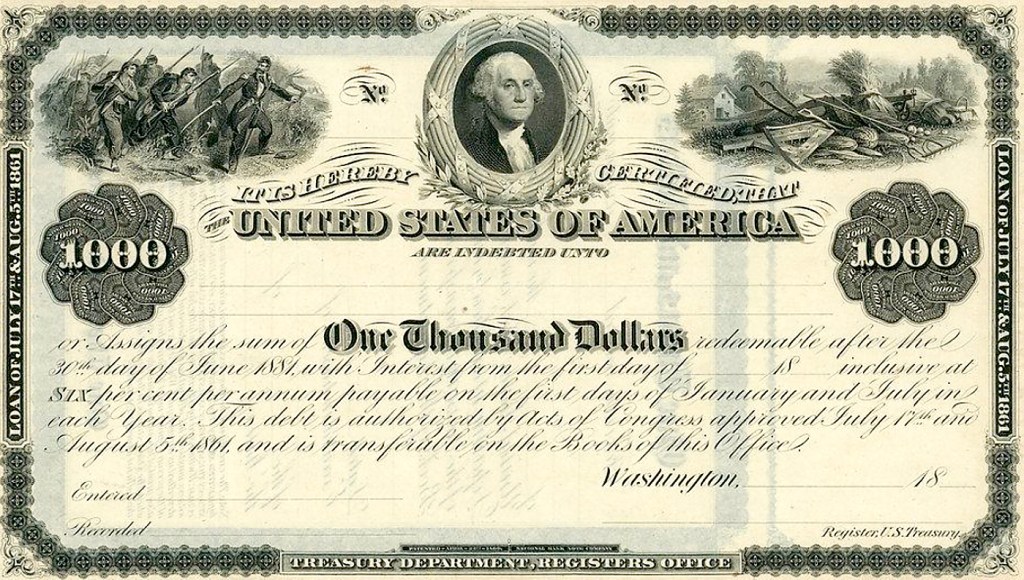
To sell the bonds throughout the United States, Jay Cooke & Company established a sales relationship with every county under the control of the United States government. One would assume that the bank within Franklin County that Jay Cooke & Company established a relationship with to sell the 5 and 20 bonds, was Farmers Bank & Trust Company. For every dollar in five and 20 bonds that Farmers Bank & Trust Company sold, they got to retain $.03 and Jay Cooke & Company retained the other $.07.
The $.03 that Farmers Bank & Trust Company and the $.07 that Jay Cooke & Company retained was not pure profit for either organization as there were internal costs that each organization had to cover. Yet, there was sufficient profit to make every bank want to be a part of selling the bonds. The five and 20 bonds were also sold in the counties of Owen, Shelby, Anderson, Woodford and Henry via a local bank
The beauty of the five and 20 bond was that anyone who bought one of the bonds became a supporter of the federal war effort. The holder of a five and 20 bond quickly realized that if they were to redeem the bond, the federal government had to defeat the Confederacy.
Within Franklin County, anecdotal evidence seems to support the belief that before 1864, only supporters of the Union cause bought five and 20 bonds, but after the Fall of Atlanta on July 22, 1864, to General Sherman’s troops, even supporters of the Confederacy began to purchase five and 20 bonds. What is of interest is that we know that a number of the five and 20 bonds sold within Kentucky were sold to women and African Americans.
Just how many five and 20 bonds were sold in Franklin County along with their overall value is unknown today. What we do know is that all that were submitted for redemption after the war were redeemed at face value plus interest earned. Before the Civil War, the United States was known for defaulting on bonds they had issued. However, after the Civil War, United States bonds were accepted at face value worldwide.
If you have any information about five and 20 bonds, please share it with the Capital City Museum.